Constraint Induced Movement Therapy Camps and Programs - Western United States Camp Bennett - San Francisco, CA - founded by Audrey Vernick, mom of a child with hemiplegic cerebral palsy Constraint Induced Movement Therapy Camps and Programs - Central United States Rehabilitation Institute of Chicago Constraint Induced Movement Therapy Camp St. Louis Children's Hospital Therapy Services - Modified Constraint-Induced Movement Therapy- summer intensive programs, Chesterfield, Missouri Constraint Induced Movement Therapy Camps and Programs - Southeastern United States Children's of Alabama Pediatric Constraint-Induced Movement Therapy Outpatient Program North Carolina Children's Hospital Modified Constraint-Induced Movement Therapy Camp - ages 3 to 10 years; primarily funded by charitable contributions and grants Powerhouse Therapy- Camp Open Hands Modified Constraint Induced Therapy Camp located in Roswell, Georgia Constraint Induced Movement Therapy Camps and Programs - … [Read more...]
Constraint Therapy – We Made It!

We made it. We survived 16 days of constraint induced movement therapy (CIMT). Whew. Now it’s about managing my expectations, and my disappointment, over what “stuck” and what didn’t. And disappointed is exactly what I felt. Within five minutes of removing the cast he immediately started using his good arm, once again abandoning his affected side. Further, for the course of the CIMT, we focused on one-handed activities using his affected arm, and now were shifting gears to work on activities that require two hands. Carry this ball, pull this accordion tube apart, open this bottle…things like that. The therapist we were working with took a video of Henry before CIMT and then again after. Before, I thought he performed admirably. She gave him a series of (two-handed) tasks and he figured out how to do them with one hand pretty quickly. Problem solving has always been his strong suit. The video afterwards was entirely different. It turns out that she had many more toys in … [Read more...]
Survey! What’s important to you?
In keeping with CHASA's mission of assisting pediatric stroke or hemiplegia researchers, we are making a survey from Teachers College, Columbia University available to you. Information about the survey is below. Dear Caregiver, Your responses to this brief questionnaire will help us prioritize our research program for children with hemiplegia at Teachers College, Columbia University based on what is important to caregivers. In addition to the summer day camps (e.g., HABIT bimanual training and CIMT), we have been developing intensive home-based interventions, training caregivers to provide the therapy. The aim is to provide support to caregivers remotely via computer (e.g., skype) to extend our programs to a broader range of the population (younger children, children outside New York City area). Your information will be ANONYMOUS unless you wish to provide contact info for more information where it will be kept private and only be seen by our research staff (or you can e-mail us … [Read more...]
Selecting a Doctor or Therapist for Your Child with Hemiplegia
Hiring a therapist or physician to treat your child who has hemiplegia is a big commitment of time, effort, and money. It's important to find someone who is both experienced and whose personality is a good fit for you and your child. You may want to interview more than one specialist before choosing the person who will work with your child. Questions to ask Health Professionals What are your professional qualifications? Are you board certified? How many children have you treated who have conditions similar to my child's condition? What have the outcomes been for those children? How long is the child usually in treatment? How often will we see you? Will you give us a home program and be available to answer questions from our childcare team? If you're uncertain about how to treat my child, who will you consult with? How can I reach you after office hours? Do you share calls with others in your office? If I'm at the emergency room will you be available to consult with … [Read more...]
Midpoint Check In – Constraint Induced Movement Therapy
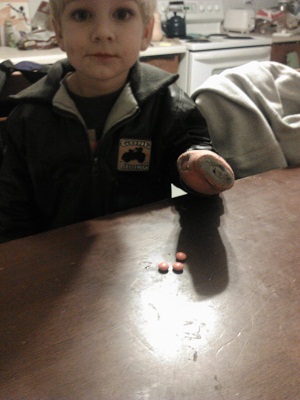
Henry, a pediatric stroke survivor who has hemiplegic cerebral palsy, is in the middle of constraint induced movement therapy (CIMT), nearly exactly at the half-way point. The first few days were impossible, for a variety of reasons. Let’s start with I didn’t really know to expect, or exactly what my role would be. I had planned out so many things, took time off of work to focus on Henry, prepared a little “therapy station” out of the train table in the playroom, set up a play date with his best bud and had a bottle of my favorite red wine on hand as my own reward. The simple stuff though, eating mac and cheese at his favorite place just down the street from the clinic led to him banging his cast over and over on the table coupled with screaming at the top of his lungs. During the lunch rush. (I assessed the situation and quickly turned it into a picnic, but should realistically never have attempted to begin with.) Eating would prove to be supremely difficult. In no time at … [Read more...]
Supination in Children with Hemiplegia

Does your child have problems turning their arm so their palm is up? This movement is called supination and many children with hemiplegia or hemiparesis have problems with supination of their affected hand. Here are some fun ways to encourage your child to supinate his or her hand. Start with the goal of helping your child move her hand to "neutral" as if shaking hands. Ringing water out of a towel by twisting it. Turning pages of a book. “Guess which hand” games, where something is hidden in one hand, the partner guesses which by tapping the guessed hand, and the hider turns both palms up and opens her hands. If correct the guesser gets a point. If not, the hider gets the point, and so on. A simple “Slinky” is a great toy to encourage supination. Hold the slinky in both hands and move it side to side. Build with cones. Build towers or set them up for “bowling”, etc. If you place or the child grasps the cone closest to the thumb, the child has to actively … [Read more...]
Holly Escapes from Her Constraint Therapy Cast
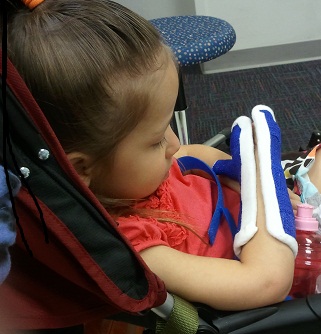
My daughter, Holly, is a sweet 5-year old girl with a number of diagnoses - Left-Sided Hemiplegia, Cerebral Palsy, Epilepsy, PDD-NOS, Developmental Delays, Behavior and Sensory Issues. One day each month, we go to St. Louis Children's Hospital for all of Holly's medical appointments. Our day begins with Physical Therapy. Holly has fun about 70% of the time. There is so much there that she has a hard time staying focused. If she sees something she that looks like it is more fun, then she is off and racing to it. We normally go to lunch and enjoy relaxing while we watch the fish. Then its off to Occupational Therapy. In April, Holly received a bi-valve cast so we could begin doing some constraint therapy at home. I warned the therapist that Holly is VERY good at getting out of any arm/hand device. In the photo, you can see the variety of braces and hand splints Holly has worn in the past. Once she got strong enough the soft hand splints started getting lost. One-by-one they … [Read more...]
A Day of Specialists

This past Wednesday I took Kohl to CP (Cerebral Palsy) clinic at Children's. This was our first time there since our move. Traffic was awful, and I was late for starters. Apparently, I can still get lost even with my GPS, lol. They were very understanding and still got us in quickly. They got Kohl's height and weight and then took us into a room to wait for the different specialists. First the CP clinic coordinator came in and told us what to expect. The OT and speech therapist came in and went over Kohl's medical history, and I added in bits as they went along. The OT and I talked about constraint therapy and casting. She also brought up spasticity clinic and botox. She suggested a new Benik splint that goes down his wrist further and has the metal stay, a new night splint, and a splint for his non-affected hand to do modified constraint at home, she suggested the constraint program at Children's and didn't want to cast him for a home program or outside program. She tested Kohl's … [Read more...]
Researchers Tests Device That Helps Infants With Cerebral Palsy Crawl
Researchers at the University of Oklahoma Health Sciences Center, in collaboration with colleagues at Virginia Commonwealth University, want to know if infants with cerebral palsy can learn to use a skateboard-like robotic device that enables locomotion. In addition, they are evaluating whether moving independently with assistance of the device will lead to improvements in problem-solving, spatial relationships, social interaction and hand-eye coordination for infants in the study. Read more. … [Read more...]
Choosing a Physical Therapist
Children with hemiparesis or hemiplegia often receive physical therapy. Physical therapy does not "cure" the cause of the hemiplegia, but it can help your child become as functional as possible and attain the best possible quality of life. Physical therapy in children is usually conducted by a pediatric physical therapist. These therapists usually work in children's hospitals, private clinics, early intervention programs, and schools. Your child's doctor may refer you to a specific physical therapist or may give you a prescription and suggest that you find your own therapist. Questions you may want to ask a potential physical therapist are: Are you a licensed pediatric physical therapist? How many years have you worked with infants or children? How many children have you seen who have my child's diagnosis? Have you taken any specialized courses that will help you work with my child? Do you primarily work with children who are recovering from orthopedic issues or do you … [Read more...]